


The History of the Blue Lagoon Malta — Before the Ferries, the Kiosks and the Crowds
Most people who visit the Blue Lagoon today see one version of it. Turquoise water. Floating pontoons. Ferry queues. Deck chairs lined up along the shore. Food kiosks. Hundreds of boats anchored in the channel.
That version of the Blue Lagoon is recent. Very recent, in the context of how long people have been visiting this stretch of water.
Before the ferries, before the kiosks, before Instagram made the Blue Lagoon one of the most photographed places in Europe — there was a different lagoon entirely. A quiet channel between two small uninhabited islands. A hiding place for corsairs. A fishing ground. A secret day out for British Navy sailors. And eventually, the location of one of the most unlikely origin stories in Maltese tourism.
This is the full history of the Blue Lagoon — from the corsairs who used it as an ambush point to the man who changed everything with fifteen packed lunches.
Told by a skipper who has been on this water every day for over 25 years, and who learned much of it from Salvu Vella — the last permanent resident of Comino, who was brought to the island as a baby in 1951 and has never left.
Blue Lagoon Malta — Key Historical Facts
| Location | Channel between Comino and Cominotto |
| Geology | Upper Coralline Limestone — creates the white sand and blue colour |
| First recorded users | Corsairs and pirates — using it as an ambush point |
| First leisure visitors | British Royal Navy — R&R trips from Marfa |
| First tourist boat | Italian entrepreneur — Sliema Promenade, 1980s |
| First ferry service | David — ex Comino Hotel worker, departing Ċirkewwa |
| First Gozo ferry | Joe Muscat — ex Comino Hotel worker, departing Mġarr |
| Peak single day visitors | 4,500 — recorded in 2015 |
| Access pass introduced | 2025 |
The Corsairs — The First Regular Visitors
Long before any tourist stepped foot on Comino’s shore, the Blue Lagoon had regular visitors. They came armed, they came fast, and they didn’t stay long.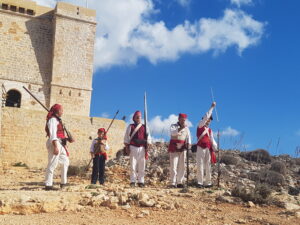
Corsairs — the pirates and privateers who operated across the central Mediterranean from the North African coast — knew the Maltese channel between Comino and Cominotto better than almost anyone. From the open sea, the channel is invisible. A vessel sitting inside the Blue Lagoon cannot be seen by a ship crossing the Malta-Gozo channel until that ship is almost directly in front of the entrance.
The corsairs used this perfectly. Small, fast boats anchored inside the lagoon — hidden from view, watching everything that passed outside. When a suitable target appeared — a merchant vessel, a fishing boat carrying cargo, or a passenger ship crossing between the islands — they moved. They intercepted the crossing, took what they wanted, and headed south toward the North African coast.
What they took was not always goods. People were taken too. Kidnapped from boats, from coastal villages, from beaches. Some were sold as slaves in cities like Jerba and Tripoli. Others ended up working on the corsair boats themselves — pulling oars, maintaining rigging, doing the manual labour that kept the vessels at sea. If your family was wealthy enough to pay a ransom, you might eventually come home. If not, you stayed.
The Blue Lagoon was their base of operations. The most beautiful bay in the Maltese islands was, for several centuries, one of its most dangerous.
For the complete story of the pirates and the Knights who tried to stop them, read here.
The Fishermen — The Channel as a Working Ground
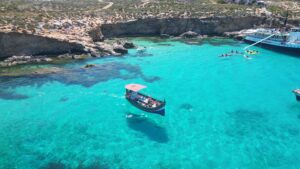
The channel between Comino and Cominotto is naturally productive water. The currents that keep it clear also bring fish through it regularly. Local fishermen understood this and worked it accordingly — setting nets on both sides of the channel, targeting sea bream and other reef species that moved through the passage with the tides.
Something else is worth knowing about how local people used the lagoon before tourism arrived. People crossing from Santa Marija Bay to Marfa or Cirkewwa did not go around the outside of the islet the way boats do today. They went straight through the Blue Lagoon channel itself — a shorter, more direct route that made perfect practical sense when the lagoon was empty and unobstructed.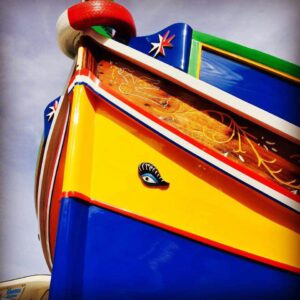
Today, the channel has a swiming zone running acros it,and it is full of swimmers. Nobody goes straight through anymore. But for generations, that direct route was simply the obvious way to cross.
The British Navy — The First Leisure Visitors
The first people to use the Blue Lagoon purely for pleasure were not tourists. They were British Royal Navy sailors — stationed at Marfa on the northern coast of Malta, brought to the lagoon for what the Navy called R&R: rest and recuperation.
The British Navy understood that sailors needed time away from their duties. The Blue Lagoon — clear, warm, sheltered, and close enough to Marfa for a day trip by boat — was an obvious choice. Groups of sailors arrived by boat, spent the day swimming in water that most of them had never seen anything like before, and returned to Marfa in the evening.
The Blue Lagoon during this period was a genuinely private place. When the British sailors left, the lagoon went back to silence.
The Italian With Fifteen Packed Lunches — The Beginning of Tourism
Every industry has an origin story. The Blue Lagoon’s tourism story begins with one man, a hotel, and fifteen packed lunches.
The exact date is uncertain — this was the 1980s, before anyone was keeping careful records of such things. But the story has been passed down among the people who worked on these waters, and the shape of it is consistent every time it is told.
An Italian man used to walk the Sliema Promenade in the mornings. He spoke to tourists — people who had come to Malta and didn’t quite know what to do with their day. He told them about a place he knew. Somewhere magical, he said. Blue water, no crowds, a day on a boat. He was persuasive. Most mornings, he gathered fifteen people.
Then he walked to a hotel and ordered fifteen packed lunches.
He had a contact — a fisherman with a boat willing to make the crossing to Comino. The group sailed to the Blue Lagoon. They had the place entirely to themselves. No other boats. No kiosks. No pontoons. Just the channel, the white sand below the water, and the cliffs of Cominotto on the other side.
This kept happening. Day after day, the Italian arrived at the hotel, asked for fifteen packed lunches, and left with a group of tourists heading for the lagoon.
Eventually the hotel manager became curious. Who was this man ordering fifteen lunches every morning? Where was he taking them?
The manager followed him.
He saw the boat. He saw the Blue Lagoon. And according to the legend, he understood immediately what was happening — and what the opportunity was.
The manager opened his own boat. He started organising his own groups. From one boat, he built to more boats. Other people saw what was working and followed. And from that beginning — one Italian man on the Sliema Promenade with fifteen packed lunches and a fisherman with a boat — the Blue Lagoon tourism industry was born.
David — The First Ferry From Ċirkewwa
As organised boat trips to the Blue Lagoon grew through the 1980s, the next step was inevitable: a regular ferry service.
The man who started it was named David. He had worked at the Comino Hotel — the only accommodation on the island, which had opened in the early 1960s near Santa Marija Bay. Through his work there, David knew the crossing between Ċirkewwa and Comino intimately. He knew the water, the timing, the demand.
He started simply. His original service was internal — running hotel guests around Comino in his traditional wooden boat, showing them the island’s caves and coastline as part of their hotel experience. Then he extended the service. From Ċirkewwa. Regular crossings. A proper ferry.
The first ferry service from Malta to the Blue Lagoon was a traditional wooden boat with a skipper who had learned the crossing by doing it for hotel guests.
Joe Muscat — The First Ferry From Gozo
Around the same time, a man named Joe Muscat was building his own operation — but from Gozo rather than Malta.
Joe had also worked at the Comino Hotel. He remembered the hotel in its early decades, when it operated under Swiss-German management. He had worked on Comino for the best part of fifty years — fishing, running charters, learning every corner of the Comino coastline in the way that only comes from being on the same water every single day for decades.
Joe started the ferry service from Mġarr Harbour, Gozo to the Blue Lagoon. For Gozo-based visitors, it solved the same problem that David’s service solved for Malta — how do you get to the Blue Lagoon without organising your own boat?
Joe Muscat still works today. He is one of the finest skippers on these waters — a man who carries fifty years of Comino knowledge in his memory. He has worked with I Malta Boat Trips. He knows where the fish are, where the currents run, and where the caves open. He still free dives. He still snorkels. He still does charters day in and day out.
He is, without question, living history.
The Growth — From One Boat to Four Hundred People
Through the 1990s and into the 2000s, the Blue Lagoon’s reputation spread. More tourists came to Malta. More boats went to Comino. The industry that began with fifteen packed lunches and a fisherman’s boat became a significant operation.
By the mid-2000s, larger vessels were entering the market. Boats carrying not fifteen people but a hundred. Then two hundred. Eventually, some carrying up to four hundred people — departing from Sliema, crossing to the Blue Lagoon, dropping passengers for three hours, and returning.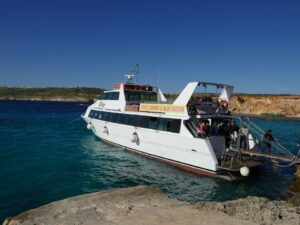
At around €35-45 per person, these large group tours made the Blue Lagoon accessible to almost anyone visiting Malta. The price was right. The logistics were handled. All you had to do was get on the boat.
But something was also being lost.
A boat carrying four hundred people lands four hundred people on the same small beach at the same time. It leaves three hours later whether you are ready or not. It follows a fixed route, stops at fixed points, and moves at the pace of the group rather than the pace of any individual within it.
The Blue Lagoon shore has 150 deck chairs and 75 umbrellas for the entire lagoon. Four hundred people arriving at once finds most of them gone within minutes.
By 2015, the Blue Lagoon was receiving 4,500 visitors in a single day at its peak. The quiet channel where corsairs once hid and British sailors once swam in complete silence had become one of the busiest stretches of water in the Mediterranean.
In 2025, the authorities stepped in. A new access system introduced three time slots per day — morning, afternoon, and sunset — each with a capped number of passes. Anyone wanting to step ashore at the Blue Lagoon now needs to pre-book a free pass at blcomino.com before arriving. The result is that the shore no longer exceeds around 4,000 people at any one time — a meaningful improvement on the uncontrolled peak days of previous years.
For visitors on a private boat who swim from the boat without going ashore, nothing changes. No pass is needed. The open water section of the Blue Lagoon — the deeper, more vivid part away from the shore entirely — remains exactly as it always was. The pass system controls the shore. The water belongs to everyone. 🚤
What the Blue Lagoon is Still Hiding
Here is what the group tour model misses — and what has always made the Blue Lagoon more interesting than its reputation suggests.
The channel between Comino and Cominotto is beautiful. It is genuinely, extraordinarily beautiful. But it is one small part of a coastline that extends for miles in every direction, with caves, reefs, hidden coves, and spots where the water is just as vivid and the crowds are essentially zero.
Crystal Lagoon — a five-minute boat move from the Blue Lagoon — has deeper colour, richer snorkelling, and far fewer people.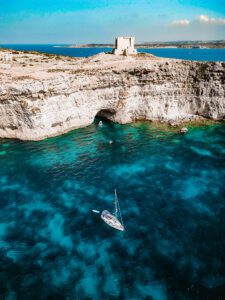 Hound Rock sits nearby, a limestone formation that looks exactly like a sleeping dog from the right angle. The caves around the Comino coastline — Lovers Cave, Popeye Cave, the Count of Monte Cristo Cave network — are all boat-access only, all extraordinary, and all completely unknown to anyone who arrived on the four-hundred-person ferry and spent their three hours on the shore.
Ta’ Ħmara. San Niklaw Gorge with its air pocket halfway through. The Outdoor Explorers Beach, created by a 2026 storm and reachable only by a boat whose skipper knows exactly where the boulders sit beneath the surface.
The Blue Lagoon is part of the Comino experience. As a skipper, I believe it should never be the whole of it.
Spending four hours on the Blue Lagoon shore is four hours in one place. A two or three-hour private boat tour covers the Blue Lagoon, the Crystal Lagoon, the caves, and spots that most visitors to Malta never find — and does it with your group, on your schedule, at your pace.
The lagoon is there. Everything around it is there. The question is how much of it you want to see.
The Access Pass — A New Chapter
In 2025, a new system changed how visitors experience the Blue Lagoon shore. An access pass — free but requiring pre-registration at blcomino.com — now controls numbers on the shore itself. Three time slots available. A specific number of passes per slot.
On a private boat, nothing changes. Guests who swim from the boat without stepping ashore need no pass. The open water section of the Blue Lagoon — the deeper, more vivid part away from the shore — remains exactly as it always was.
For the complete pass guide, read here.
See It the Way It Was Always Meant to Be Seen
The Blue Lagoon is most beautiful early in the morning — before the ferries start, before the crowd builds, when the water is flat and calm and reflects the limestone cliffs around it in a way that our skippers call the white sea. In those early hours, the lagoon feels the way it must have felt when the British sailors arrived to swim, when the fishermen set their nets, when the corsairs waited in the silence between islands.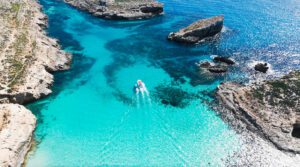
A private boat departing from Ċirkewwa or Mġarr Harbour in Gozo reaches the Blue Lagoon in ten minutes. At 08:30 in the morning, before any ferry has left the terminal, the lagoon is yours.
Book your private boat tour here.
For the complete Blue Lagoon guide, read here.
For the best time to visit the Blue Lagoon and avoid crowds, read here.
For who still lives on Comino today, read here.
For the secret history of Comino, read here.
FAQ — History of the Blue Lagoon Malta
What is the history of the Blue Lagoon in Malta?
The Blue Lagoon has been used by corsairs as an ambush point, by local fishermen as a working ground, by the British Royal Navy for rest and recuperation, and eventually by tourists from the 1980s onward. The first organised tourist trips were started by an Italian entrepreneur on the Sliema Promenade. The first ferry services were started by David from Ċirkewwa and Joe Muscat from Mġarr in Gozo.
Did pirates really use the Blue Lagoon?
Yes. Corsairs from the North African coast used the channel between Comino and Cominotto as a hiding point — sheltered from view, watching ships cross the Malta-Gozo channel and attacking suitable targets. They took cargo and people, with captives sometimes sold into slavery in Jerba and Tripoli.
Who started the first ferry to the Blue Lagoon?
A man named David — who had worked at the Comino Hotel — started the first regular ferry service from Ċirkewwa to the Blue Lagoon. Joe Muscat started the equivalent service from Mġarr Harbour in Gozo around the same time. Both had worked at the Comino Hotel and knew the crossing intimately.
What was the Blue Lagoon like before tourism?
Before organised tourism, the Blue Lagoon was a quiet fishing ground and occasional anchorage. The only regular leisure visitors were British Royal Navy sailors brought from Marfa for rest days. The shore had no facilities, no deck chairs, no kiosks — just the water and the cliffs.
Who started Blue Lagoon tourism in Malta?
According to local legend, an Italian entrepreneur on the Sliema Promenade started gathering groups of fifteen tourists, ordering packed lunches from a hotel, and sailing them to the Blue Lagoon in a fisherman’s boat in the 1980s. The hotel manager followed him, discovered the opportunity, and opened his own boat service — starting the industry.
How many people visit the Blue Lagoon today?
At its peak, the Blue Lagoon receives up to 4,500 visitors in a single day during peak summer season. An access pass system introduced in 2025 now controls numbers on the shore itself.
Is a private boat better than a group ferry for the Blue Lagoon?
A private boat anchors in the open water away from the shore crowd, includes Crystal Lagoon and the sea caves, and adapts the route to your group. The group ferry drops you on the shore with everyone else for a fixed time. Both reach the same lagoon — but they are completely different experiences.
What time is the Blue Lagoon best to visit?
Before 09:00 — when the water is flat and calm, the colour is most vivid, and the shore is empty. A private boat departing Ċirkewwa or Mġarr at 08:30 reaches the lagoon before any ferry crowd arrives.
Is Joe Muscat still running boat tours from Gozo?
Yes — Joe Muscat, who started the first Gozo to Blue Lagoon ferry service and has been working on these waters for over fifty years, still runs charters today. He is one of the most experienced skippers on the Comino coastline and has worked with I Malta Boat Trips.
What is the white sea at the Blue Lagoon?
The white sea is the name our skippers use for the mirror-calm morning condition at the Blue Lagoon — when the water surface is completely flat and reflects the surrounding limestone cliffs. The colour of the lagoon in these conditions is more vivid than at any other time of day. It happens in the early morning and occasionally in the late evening.
Further Reading
- Blue Lagoon Malta — Complete Guide 2026
- Best Time to Visit Blue Lagoon — Avoid the Crowds
- Blue Lagoon Malta Tickets and Access Pass 2026
- Secret History of Comino — Pirates, Knights and War
- Who Lives on Comino? The Last Residents
- Crystal Lagoon Malta — Complete Guide
- Comino Island Malta — Complete Guide 2026
- How to Get to the Blue Lagoon from Gozo
- Gozo to Comino Ferry vs Private Boat
- The Forgotten Farming History of Comino