



The Secret History of Comino Island Malta — Pirates, Knights, Plague and War
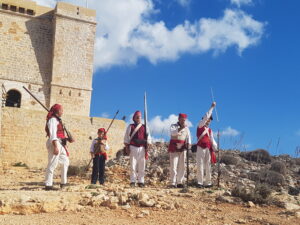
Comino has been inhabited since Roman times. It was used by pirates as an ambush point, fortified by the Knights of St John in 1620, turned into a plague hospital by the British, and bombed during World War Two. This is the complete history of Comino island — told by a skipper who passes these caves, towers and cannon batteries every single day
And the water is extraordinary — turquoise, clear, unlike anything else in the Maltese islands. But Comino is much more than a beautiful lagoon. It is a small island with a very long and very dramatic history. An island that has been farmed, fought over, used as a prison, turned into a plague hospital, bombed during a world war, and used by pirates as a hiding place for centuries.
Almost none of the visitors who arrive by ferry every summer know any of this. They see the blue water and they photograph it — and they go home without knowing that they spent the day on one of the most historically layered places in the entire Mediterranean.
This guide changes that.
Written with the help of a skipper who has been on these waters every single day for over 25 years — passing the caves, the towers, the cannons, and the cliffs that are the physical remains of everything that happened here.
Why Is the Water at Comino So Blue?
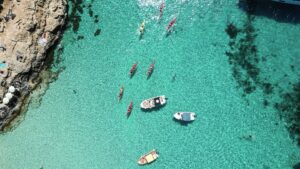
Before the history — the science. Because the water is not just beautiful. There is a specific reason it looks the way it does. And understanding it makes everything else make more sense.
Comino is the only island in the Maltese archipelago made entirely of Upper Coralline Limestone. This particular type of rock breaks down over time into very fine, very white sand. That white sand sits on the seabed and reflects the sunlight upward through the water. The result is the vivid, electric blue colour that makes the Blue Lagoon look the way it does in photographs — and in real life.
Comino also sits in a position where sea currents pass through the channel between Malta and Gozo more actively than in the sheltered bays on either side. Those currents keep the water moving and clear. High visibility. No sediment. Pure blue.
You will find beautiful water in other parts of Malta and Gozo. But you will not find water that looks exactly like Comino’s water anywhere else in the islands. The geology will not allow it.
Before the Knights — Roman Comino
The history of Comino begins long before the pirates. Long before the Knights of St John. Long before anyone reading this was born.
Roman remains have been found at Santa Marija Bay — the sheltered bay on the north side of the island where the hotel once stood and where Salvu Vella still launches his fishing boat today. People were living on Comino during Roman times. Farming it. Fishing from it. Using its sheltered bays as stopping points on the sea routes that connected Rome’s empire across the Mediterranean.
The island is named after the spice cumin — Kemmuna in Maltese — which grew wild across its rocky landscape in earlier centuries. It was a useful island. A productive one. Long before it became a dangerous one.
The Pirates and Corsairs — The Chapter Everyone Wants to Hear
Ask any skipper what history guests respond to most on a Comino boat tour. The answer is always the same.
The pirates.
From the 15th century onward, the waters around Comino were some of the most dangerous in the Mediterranean. Corsairs — armed privateers, many operating from the North African coast — used the Maltese islands as a hunting ground. They were fast, they were organised, and they knew the coastline far better than the people they were attacking.
Comino, with its maze of sea caves, hidden coves, and channels between islands, was perfect for them.
The Blue Lagoon — A Pirate Ambush Point
The most extraordinary detail — and the one that changes how you see the Blue Lagoon forever — is this: pirates used to hide inside the Blue Lagoon itself.
The channel between Comino and the tiny islet of Cominotto is narrow, sheltered, and invisible from the open sea until you are almost inside it. A small corsair vessel, anchored quietly inside the lagoon, could not be seen by a merchant ship crossing the channel between Malta and Gozo. But from inside the lagoon, the corsairs could see everything passing in the open water outside.
When a suitable target appeared — a merchant vessel, a fishing boat carrying valuable cargo — they moved. Fast, low boats built for speed rather than cargo. They intercepted the crossing vessel, took what they wanted, and headed back toward the North African coast before any alarm could be raised.
The Blue Lagoon, which today is visited by hundreds of thousands of peaceful tourists every summer, was once one of the most carefully chosen ambush points in the central Mediterranean.
The Sea Caves — Where Boats Disappeared
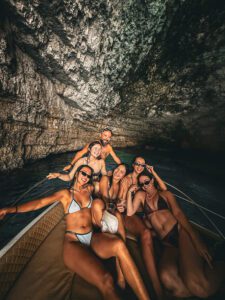
The caves around Comino’s coastline were equally useful for the corsairs — not just for hiding in, but for hiding through.
The cave known today as the Count of Monte Cristo Cave — named because it was used as a filming location for the movie adaptation of Alexandre Dumas’ novel, for the scene where the treasure of Spada is hidden — is the most striking example. The cave system has multiple chambers connected by underwater passages. A small boat could enter from one side, move through the cave, and surface in a completely different location where nobody watching the entrance would ever see it emerge.
This is not a coincidence of geography. It is exactly the kind of feature that corsairs actively sought out and used. Enter from one side, exit from the other. Disappear.
Santa Marija Caves — larger, more open — were big enough to hide substantial vessels. The rock walls concealed them from passing ships completely. Lovers Cave, which sits beneath the Comino Tower, was large enough to shelter a smaller boat well inside the cliff face.
The caves were also used for smuggling operations — moving goods that bypassed the ports, the customs officers, and the taxes of whoever was currently governing the island.
For the complete caves guide, read here.
The Knights of St John — Building the Defence
The Knights of St John ruled Malta from 1530 to 1798. They were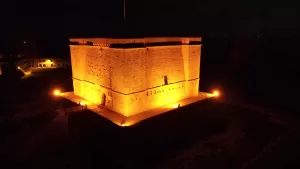 a military religious order — disciplined, wealthy, and deeply experienced in Mediterranean warfare. They understood the pirate and corsair threat better than almost anyone, because they had been fighting it for centuries.
Their response to the corsair threat on Comino was practical and precise. They built two structures that still stand today.
Saint Mary’s Tower — Kemmuna Tower
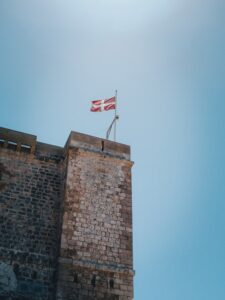
Saint Mary’s Tower — built by Grand Master Alof de Wignacourt and completed in 1620 — stands at the highest point of Comino. It is the largest and most expensive watchtower the Knights ever built on the Maltese islands.
Its purpose was simple: to see danger coming before it arrived.
When a corsair ship appeared on the horizon, the soldiers in the tower lit a fire on the roof. That fire was visible to the next tower along the chain — the Red Tower at Mellieħa on Malta, and the Garzes Tower at Mġarr on Gozo. Each tower passed the signal to the next, fire to fire, across the islands. The alarm reached Valletta and Mdina within minutes. Reinforcements were dispatched.
It was the medieval equivalent of a communication network — slow by modern standards, but fast enough to make a real difference.
The tower is open to the public on Wednesdays, Saturdays and Sundays from April to October. A flag flies when it is open. From the top, you can see exactly what the Knights’ sentries saw — the full sweep of the channel between the islands, and every vessel moving through it.
Saint Mary’s Battery — The Cannons Still There
Saint Mary’s Battery — built in 1715 and 1716 — sits on the southern coast of Comino, directly above the stretch of water known today as the Kissing Elephants area. It was built not just to defend but to direct.
The battery was armed with two 24-pound cannons and four 6-pound cannons, all facing south toward the channel between Comino and Malta. When an enemy ship came close enough, the battery opened fire — not necessarily to sink it, but to force it to change direction.
A ship being fired on from the south of Comino had only one sensible direction to go: north. Away from the battery. Toward the coast of Malta near Marfa and Armier. And waiting on that side of the channel was another battery — ready to attack from the opposite direction.
The Knights did not just build fortifications. They built a system. Every battery, every tower, every cannon was placed to work together — pushing enemy vessels into killing grounds where they could be attacked from multiple sides at once.
The battery was restored in the 1990s. The original cannons — retrieved from a gorge beneath the battery in a joint operation by the Armed Forces of Malta and the Royal Navy in 1997, using a helicopter from HMS Illustrious — are mounted there still. You can see them from a boat passing along the southern Comino coastline.
For the complete guide to Saint Mary’s Battery and the Kissing Elephants area, read here.
The British Era — Prisoners, Plague, and a Hospital That Was Never Really Needed
The Knights of St John surrendered Malta to Napoleon in 1798. The French occupation was brief and unpopular. By 1800, the British had arrived — and they stayed for over 150 years.
Comino played a specific and somewhat surprising role in the early years of British rule.
The French Sympathisers
When the British took control, they had a problem. Malta had a significant number of people who had supported — or were suspected of supporting — the French. They needed somewhere to put them. Somewhere secure, isolated, and difficult to escape from.
Comino was the answer.
French sympathisers were imprisoned on Comino — held in the tower and its surrounding buildings, on an island with no road connections, surrounded by open sea. It was a practical solution. The island’s isolation, which made it attractive to farmers and difficult for pirates, made it equally effective as a place of detention.
The Isolation Hospital — Built for a Plague That Never Came
In the 1890s, the British built an Isolation Hospital on Comino — an extension of the Palace building that already stood near Saint Mary’s Tower.
The reason was a very specific fear. The ports of the Levant — the eastern Mediterranean — were experiencing outbreaks of plague and cholera. Ships coming from those ports called at Malta regularly. If plague arrived on a ship in the Grand Harbour, it could spread through the population of the islands rapidly.
The plan was to bring any infected patients to the Isolation Hospital on Comino — far from the main population, surrounded by sea, impossible to leave without a boat. A quarantine island within an archipelago.
The hospital was built. The equipment was put in place. The staff were trained.
And then, thankfully, the plague never came.
The hospital was used occasionally — wounded soldiers from the Dardanelles campaign in World War One were treated there. But it never saw the epidemic it was designed for. The building still stands today, next to the Palace, its walls still carrying the quiet authority of something that was built for a crisis that never arrived.
World War Two — Bullet Holes, War Shelters, and a Cemetery
Comino did not escape the Second World War untouched.
The Bullet Holes You Can Still See
On the back wall of the Palace building — the 17th century structure near the tower where the Vella family lived for generations — there are machine gun bullet holes that are still clearly visible today.
A plane dive-bombed the complex during the war. The bullets hit the wall and stayed there. Nobody filled them in. Nobody covered them up. You can walk up to the wall and put your fingers in them.
It is one of those moments — a physical mark on an old building — that connects you directly to a specific moment in history more effectively than any photograph or description.
The War Shelters
Across Comino, there are at least three World War Two air raid shelters cut into the rock — places where the people on the island could hide when aircraft were overhead. There are almost certainly more that haven’t been fully documented.
Most visitors never find them. They are not marked on tourist maps. They are not mentioned on ferry tours. But they are there — dug by hand into the limestone, dark and cool and still intact, waiting for a danger that has long since passed.
The Comino Cemetery
In the small walled cemetery near the centre of the island, Italian and German servicemen who died in the waters around Comino during the war were buried. Their bodies were repatriated to their home countries in the 1960s. The cemetery is now empty and no longer in use — the remains of the island’s own residents were moved to Għajnsielem on Gozo. But the cemetery is still there, walled and quiet, in the middle of an island most people only visit for the beach.
The Comino That Exists Today
Comino has been farmed, fortified, fought over, used as a prison, converted into a quarantine zone, and bombed from the air. It has been home to Roman settlers, Arab traders who left their name on the cumin spice, corsairs from the North African coast, Knights of St John, British colonial administrators, a farming company, a hotel, and — for nearly a century — the Vella family.
Today it is visited by hundreds of thousands of people a year, almost all of them there for the water.
The water is extraordinary. But so is everything underneath it — not just the marine life and the sea caves, but the layers of human history that have accumulated on this small island over two thousand years.
Every time I pass Comino on the boat — the Tower on the hilltop, the Battery cannons visible on the southern cliff, the caves opening in the rock face — I think about all of it. The corsairs hiding in the Blue Lagoon. The Knights watching from the tower roof. The soldiers who were buried here and went home decades later. The Vella family who were here through all of it and are still here now.
Comino is a small island. But it is not a simple one.
See It For Yourself — From the Water
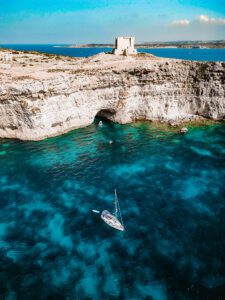
The best way to understand Comino’s history is to see it from the sea — the same perspective that every pirate, corsair, Knight, sailor, and visitor has had for two thousand years.
From a private boat, you can pass the Battery cannons on the southern cliffs. You can enter the caves the corsairs used. You can anchor in the Blue Lagoon where the pirates waited. You can look up at the Tower that sent fire signals across the islands. The history is not in a museum. It is on the water, on the rocks, and in the caves — exactly where it always was.
Book your private Comino boat tour here.
For the complete Comino guide, read here.
>For the best things to do on Comino, read here.
>For the complete caves guide, read here.
>For who lives on Comino today, read here.
Comino Island — Key Historical Facts
| First inhabited | Roman times — remains found at Santa Marija Bay |
| Named after | Cumin spice — Kemmuna in Maltese |
| Saint Mary’s Tower built | 1620 — by Grand Master Alof de Wignacourt |
| Saint Mary’s Battery built | 1715-1716 — by the Order of Saint John |
| Isolation Hospital built | 1890s — by the British, for plague patients |
| World War Two | Palace dive-bombed — bullet holes still visible |
| War shelters | At least 3 cut into the rock |
| Current permanent residents | 1 — Salvu Vella |
FAQ — History of Comino Malta
What is the history of Comino island Malta?
Comino has been inhabited since Roman times. It was used by pirates and corsairs as a hiding place for centuries. The Knights of St John built Saint Mary’s Tower in 1620 and Saint Mary’s Battery in 1715 to defend against these attacks. Under British rule it was used as a prison for French sympathisers and a site for an Isolation Hospital built during a plague scare. During World War Two it was dive-bombed and used as a burial site for enemy servicemen. Today it is home to one permanent resident — Salvu Vella.
Did pirates really use Comino?
Yes. Corsairs used the Blue Lagoon as an ambush point — hiding inside the channel between Comino and Cominotto and attacking ships crossing between Malta and Gozo. They also used Comino’s sea caves to hide boats and conduct smuggling operations.
What is Saint Mary’s Tower on Comino?
Saint Mary’s Tower — also known as Kemmuna Tower — was built by the Knights of St John in 1620. It was used to spot enemy ships and send fire signals to other towers across Malta and Gozo. It is the largest watchtower the Knights ever built on the Maltese islands. It is open to the public from April to October.
What is Saint Mary’s Battery on Comino?
Saint Mary’s Battery is an artillery fortification built by the Knights of St John in 1715 on the southern coast of Comino. It was armed with six cannons designed to force enemy ships northward into a second line of fire on the Malta coast. The original cannons are still mounted there today.
Why is the water at Comino so blue?
Comino is the only island in Malta made entirely of Upper Coralline Limestone. This rock breaks down into very fine white sand which reflects sunlight upward through the water creating the vivid blue colour. Sea currents passing through the Comino channel also keep the water exceptionally clear.
Were there really war shelters on Comino?
Yes — there are at least three World War Two air raid shelters cut into the rock on Comino. They are not marked on tourist maps and most visitors never find them.
Is there a cemetery on Comino?
Yes — a small walled cemetery near the centre of the island. Italian and German servicemen buried there during World War Two were repatriated to their home countries in the 1960s. The cemetery is no longer in use.
Did the plague ever reach Comino?
No. The British built an Isolation Hospital on Comino in the 1890s specifically to deal with potential plague outbreaks arriving on ships from the eastern Mediterranean. Thankfully the plague never reached the Maltese islands and the hospital was rarely used for its intended purpose.
What is the history of Comino island Malta?
Comino has been inhabited since Roman times — remains have been found at Santa Marija Bay. For centuries it was used by pirates and corsairs who hid in its sea caves and the Blue Lagoon. The Knights of St John built Saint Mary’s Tower in 1620 and Saint Mary’s Battery in 1715 to defend against these attacks. Under British rule the island was used to imprison French sympathisers and an Isolation Hospital was built in the 1890s for potential plague outbreaks. During World War Two the Palace was dive-bombed and three air raid shelters were cut into the rock. Today one permanent resident — Salvu Vella — still lives on the island.
Where is the Count of Monte Cristo Cave on Comino?
The Count of Monte Cristo Cave is a sea cave network on the Comino coastline used as a filming location for the Count of Monte Cristo movie. Local legend and historical record suggest it was also used by pirates and smugglers for centuries due to its multiple connected chambers and underwater passages. Read the complete guide here.
Further Reading
- Comino Island Malta — Complete Guide 2026
- Who Lives on Comino? The Last Residents
- The Kissing Elephants Arch — What We Know
- Count of Monte Cristo Cave Comino
- Lantern Point Comino — Complete Guide
- Crystal Lagoon Malta — Complete Guide
- Comino Sea Caves — Complete Guide
- Blue Lagoon Malta — Complete Guide 2026
- Best Things To Do on Comino 2026
- Best Snorkelling Spots Malta, Gozo and Comino 2026
- Santa Marija Bay Comino — Complete Guide