


The Forgotten Farming History of Comino — Peaches, Honey and the Island Nobody Knew
Most people think of Comino as a beach destination. You visit for the Blue Lagoon, spend a few hours in the water, and go home.
But for most of its modern history, Comino was a working farm. Its valleys grew peaches, cherries, tomatoes, strawberries, and beans. Wild thyme honey was produced here that you cannot find anywhere else in Malta. Stone rubble walls divided the fields, and a small community of farming families worked the land through every season.
Almost none of the hundreds of thousands of visitors who arrive by ferry every summer know any of this. They swim in the Blue Lagoon and leave without knowing that the island beneath their feet was once one of the most productive small farms in the central Mediterranean.
This is that story — told by a skipper who passes Comino’s old valleys, wells, and field boundaries every single day, and who still points them out to guests from the boat.
Comino Island — Key Farming Facts
| Island name origin | Cumin — Kemmuna in Maltese, Kemmun in Arabic |
| Farming company | The Comino Farming Company — Arthur Zammit Cutajar |
| Farming lease granted | 1926 |
| Farming lease ended | 1960 |
| Main crops | Tomatoes, cherries, peaches, plums, strawberries, beans, potatoes, melons |
| Main herbs | Wild thyme, cumin, dill, fennel, capers |
| Honey type | Wild thyme honey — only produced on Comino in all of Malta |
| Soil type | Ħamrija — rich, red-brown, highly fertile |
| Wells on the island | At least 4 — San Niklaw Valley, Ta’ Ħmara, Santa Marija, Ħażiena |
The Name Says It All — Comino and Cumin
Comino’s name is not a coincidence. It is a description.
Comino comes from the Spanish word for cumin — the spice. In Maltese, the island is called Kemmuna, and kemmun is the Maltese and Arabic word for that same spice. Cumin grew wild and plentiful across Comino for centuries before any farming company arrived.
This matters because it tells you something important. Comino was not just beautiful. Farmers, traders, and travellers all recognised it as a useful island — one where the soil, the climate, and the position between Malta and Gozo created conditions where herbs and crops grew with remarkable quality.
Walk across Comino today and you still find cumin growing wild. Dill too. Fennel. And above all else — wild thyme, covering most of the island’s surface, turning purple every April when it flowers. The name stuck because the plants that gave the island its identity are still there, exactly where they always were.
What Comino Looked Like as a Working Farm
To understand the farming era, picture Comino completely differently from how it looks today.
Every valley on the island — Santa Marija, San Niklaw, Ta’ Ħmara (the Red Valley), and Ħażiena — was carefully divided by stone rubble walls. Low, dry-stone walls, the same kind you still see across the Maltese countryside. Each section defined a field. Each field had a purpose — fruit trees along the borders for shade and wind protection, crops planted in the centre, water channels running down from the wells above.
Farming families maintained those walls by hand. Every fallen stone went back into place. Every path stayed clear. Every well got checked before each growing season.
Fruit trees lined the field edges. Cherries, peaches, plums — planted with the long view in mind, knowing that trees take years to establish and decades to produce at their best. Planting them was an act of confidence in the future.
When the farming ended in 1960 and most families left, nobody maintained the walls. Rain loosened the stones. Winter storms brought sections down. And when a rubble wall falls in Malta, the soil behind it goes with it — washed down the hillside by the next heavy rain, toward the sea. Fertile Ħamrija soil that took centuries to accumulate disappeared within a generation in some places.
Between 2018 and 2021, a government-employed team went across Comino and rebuilt a significant number of those collapsed walls — restoring the boundaries of fields abandoned for 60 years. Most walls near the paths and tracks have been fixed. Toward the centre of the island, some still lie collapsed — fallen stones, gaps in the old boundary lines, the outline of a field nobody has farmed in living memory.
The Soil That Made Everything Possible — Ħamrija
Not all Mediterranean soil is the same. Comino’s is different — and the difference is significant.
Ħamrija — the Maltese word for a specific type of soil — is red-brown, deep, and unusually fertile by the standards of a small limestone island. Comino holds it in abundance, particularly in its valleys where centuries of organic matter built up in the lower ground.
Ħamrija is what made Comino’s produce exceptional. Its cherries, peaches, and plums were not just good by island standards — they were outstanding. Salvu Vella’s father used to say it was better to eat the fruit than sell it. For a farming family working hard to earn a living, that tells you everything about how good the fruit actually was.
Every crop planted in Comino’s valleys seemed to produce better than it had any right to. The tomatoes were extra sweet. The strawberries grew well. The potatoes were reliable. A small island in the middle of the sea, producing food that people still remember decades after the farming stopped.
What Was Actually Grown on Comino
🍯 The Wild Thyme Honey — Unlike Anything Else in Malta
Comino is the only place in the Maltese islands where you can get wild thyme honey. And the reason is simple.
Almost every other island and coastal area in Malta has a mix of vegetation — fields, gardens, and some wild plants. Comino is different. Most of its surface is garigue — the low Mediterranean scrubland dominated almost entirely by wild thyme. Every April, the whole island turns purple as the thyme flowers open. Bees find those flowers within days of flowering and work them intensively throughout spring.
Thyme honey looks and tastes different from ordinary honey. Darker in colour. More liquid in consistency. Richer in taste, with a deep herbal character that reflects exactly where it came from.
Arthur Zammit Cutajar — who ran the Comino Farming Company from 1926 — recognised this immediately. He brought bees from Italy specifically to produce thyme honey on Comino. That honey became one of the island’s most valued exports, sold for one shilling and sixpence per pound — a premium price at the time.
Today, the tradition continues. Salvu Vella still keeps bees and produces honey for himself. Veggie does the same. Their friend George Baldacchino maintains colonies on the island and sells Comino wild thyme honey at Marsaxlokk market every Sunday. If you want to taste what Comino’s land produces, that is where to go.
🍅 The Tomatoes and the Sicilian Bamboo Technique
Among the farming families who came to work on Comino, a family arrived from Sicily. With them came a technique for growing tomatoes that the other farmers hadn’t seen before.
Instead of letting plants grow low along the ground, the Sicilians used bamboo — Qasba in Maltese — cut into poles and pushed into the soil beside each plant. Farmers tied the tomato stems to the bamboo as they grew, training them upward to around five feet. More sun reached each plant. The fruit ventilated better. Yields climbed significantly compared to ground-grown plants.
Combined with Comino’s Ħamrija soil, the result was cherry tomatoes of exceptional quality — extra sweet, thin-skinned, intensely flavoured. The technique spread among the other farming families and became standard practice on the island.
Bamboo still grows in sheltered spots on Comino today.
🌿 The Capers — And Veggie’s Secret Recipe
Capers grow wild all over the Maltese islands — from wall crevices, cliff faces, and rubble boundaries between old fields. On Comino, they grow plentifully and farmers harvested them for generations.
Most people prepare capers the same way: one part salt, nine parts water, leave them submerged until they soften and develop their flavour.
Veggie — Evangelista Buttigieg, one of Comino’s last residents — had her own method. Instead of salt brine, she used one part sugar, eight parts water, and one part vinegar. Firmer in texture. Richer in taste. A complexity that the plain salt version simply doesn’t achieve.
Capers flower from April through to mid-summer — and the more you pick them, the more they produce. Veggie understood this better than anyone. Most evenings from around 5pm, when the heat of the day had passed, she walked the walls and garigue across the island harvesting capers by hand. Patient, methodical work — the kind that only someone who has lived on the same small island their whole life would do without thinking twice about it.
When the Comino Hotel was still open, the hotel staff used to come to her directly to collect what she had prepared. She didn’t deliver to them — they came to her. And they kept coming back, because Veggie’s capers — prepared with her own sugar, water, and vinegar method rather than the standard salt brine — were simply better than anything they could source elsewhere.
They are, without question, some of the best capers I have ever tasted. 🌿
🍑 The Fruit — Cherries, Figs, Mulberries, Peaches and Plums
Fruit trees were the farming families’ most valuable long-term investment. Planting them took patience — years to establish, decades to reach full production. Putting them in the ground was a statement that said: we are here to stay.
Comino’s cherries, peaches, and plums earned a strong reputation. The Ħamrija soil, the island’s microclimate, and the care taken in cultivation produced fruit sweet enough that Salvu’s father concluded it was genuinely better to eat it than take it to market.
Some fruit did go to market — carried by boat to Gozo and then to Marfa on Malta, sold through agents who distributed it further. But the return barely covered the effort. The fruit was better than its market price suggested.
Some of the original trees planted during the farming era still stand on Comino today — older, less tended, but still producing in season.
🌱 Cumin, Thyme and Fennel
Beyond the cultivated crops, Comino’s wild herb population was and remains extraordinary.
Cumin — the spice the island is named after — still grows here. Thyme spreads across the garigue and along path edges. Fennel appears in the valleys throughout all year round. Wild thyme covers most of the island’s surface and flowers purple every April.
None of these plants need tending. They grow because Comino’s soil and climate suit them perfectly — as they have for thousands of years. The island was named for its herbs long before anyone thought to farm it systematically. The herbs outlasted the farm. They are still there now.
The Comino Farming Company — Arthur Zammit Cutajar
In 1926, the Maltese government granted a lease to Arthur Zammit Cutajar to establish a horticulture business on Comino. His company — the Comino Farming Company — brought workers to the island on four-year renewable contracts, provided tools, seeds, and accommodation, and began the organised cultivation of Comino’s valleys.
Zammit Cutajar ran the operation with energy and ambition. He planted trees across the island — fruit trees, shade trees, trees for soil stabilisation. Italian bees arrived for the thyme honey. A shop opened in 1927 selling basic goods to the island community. In 1928 he lobbied the government for a school for the workers’ children — and it opened in 1929, staying open until 1965.
Among the more unusual exports: one worker collected snails — then plentiful across the island — and sent them to Italy. Every product the island produced found a buyer somewhere.
The lease ended in 1960. The company wound down. Most workers and families moved to Malta and Gozo. The Vella family stayed.
The Wells — Where the Water Came From
Every farm needs water. On a small limestone island with no rivers and limited rainfall, water management was one of the most critical skills the farming families held.
Comino’s wells are old. Very old. Nobody knows exactly when the first ones were dug — but they predate the farming company, predate the British, and in some cases may predate the Knights of St John themselves. They were already there when the farming families arrived in 1926. The families simply used what the island had always provided.
Later, the government drilled a series of bore holes across the island to supplement the old wells — going deeper into the rock to access larger underground water reserves. For a time, Comino had both: the ancient hand-dug wells that had served the island for centuries, and the modern bore holes drilled by machinery. Salvu Vella and his brother Anglu maintained both systems for decades through their work with the Water Services.
At least four wells and multiple reservoirs remain across the island today — each one positioned where the underground water table sat closest to the surface:
Wied il-Aħmar — the Red Valley: A water reservoir sits here, with a well positioned right beside it. Together they served the fields in the valley behind the Blue Lagoon — one of the most productive stretches of farmland on the island.
Il-Lifrat: A second reservoir and well with fresh water — another carefully chosen location where the farming families knew the water table was reliable and accessible throughout the growing season.
Santa Marija Bay: Close to the bay, on the east side of the campsite, sits one of the most unusual and possibly the oldest well on the entire island. Unlike every other well on Comino — all circular — this one is cut directly through the rock in an oval shape. Nobody knows exactly when it was made or why it was built differently from all the others. But given that Roman remains have been found at Santa Marija Bay, and given the well’s unusual construction, it may date back to the Roman period itself — making it potentially over 2,000 years old. People have been drawing water from this spot for longer than most buildings in Europe have been standing. Its age and its shape make it unlike anything else on the island — and almost nobody who visits Comino knows it is there.
San Niklaw Bay: Another well with fresh water, located close to Triq Kemmunett. Farming families working the northern valleys relied on it throughout the growing season, and later the hotel and its workers used it too.
Fresh water sits above salt water underground — shallow wells produce fresh water, but go too deep and salt water seeps in from the surrounding sea. The farming families understood this precisely. They knew exactly where to dig and exactly how deep to stop.
The bore holes are no longer active. But the old wells are still there — some of them centuries old, others possibly millennia old, all cut by hand into the limestone, outlasting every farm, every company, and every generation that depended on them.
Most visitors to Comino spend their entire day in the Blue Lagoon and never know these wells exist. But from a private boat, your skipper can point out the valleys where each one sits — and on longer tours that include time ashore, you can walk to them yourself. History that most people walk straight past without knowing it is there. 💧
What You Can Still See Today
Comino’s farming past has not disappeared. You just need to know where to look.
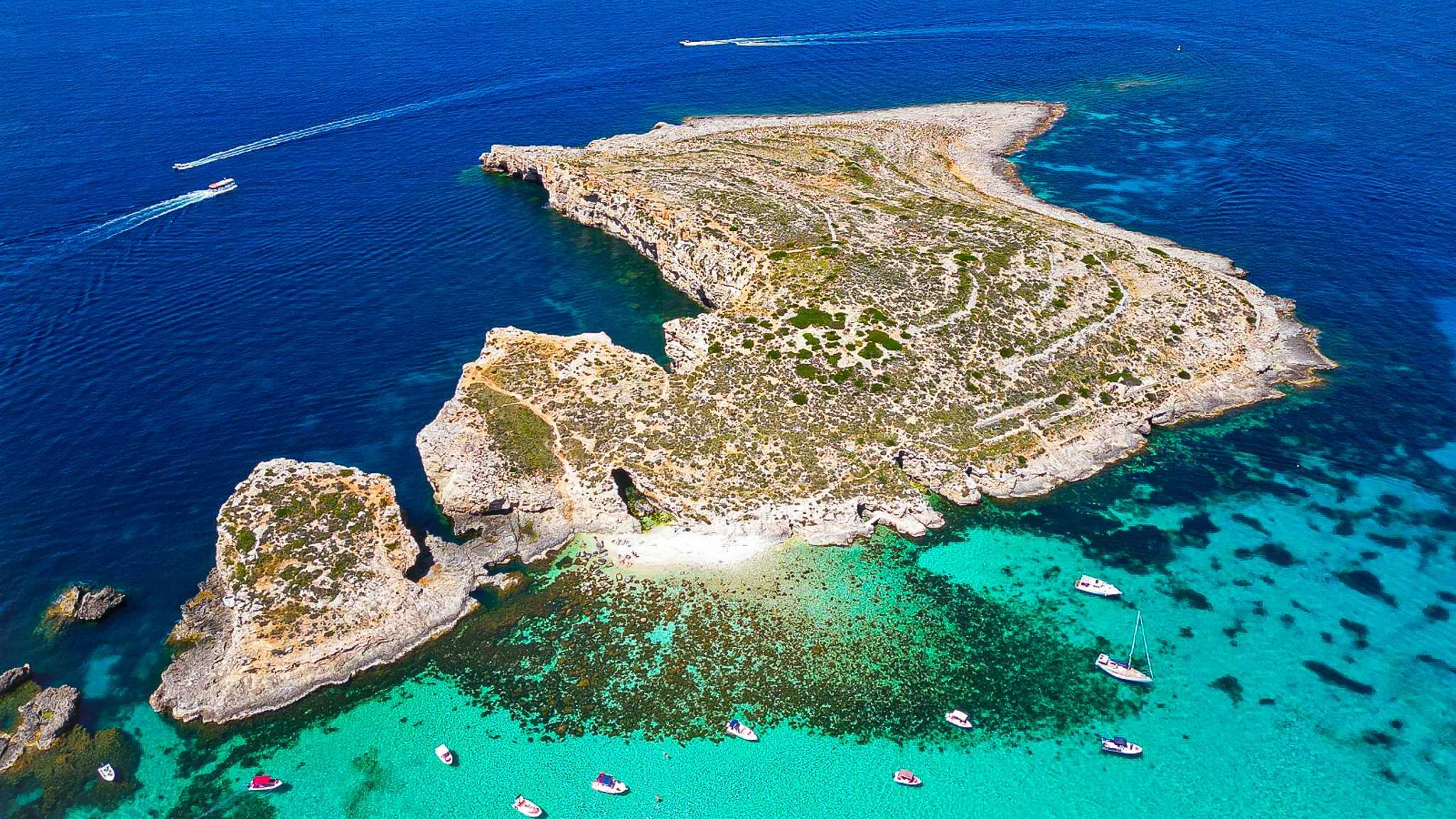
From the water, on a private boat passing the coastline, the valley shapes that defined the old field system are clearly visible — lower ground where the Ħamrija soil accumulated, higher limestone edges where the rubble walls once ran.
On land — our longer tours sometimes include a stop at Santa Marija Bay or Crystal Lagoon to go ashore — the farming era is visible and touchable:
🌿 Wild thyme — covering the garigue, turning purple every April, the source of the island’s famous honey
🌱 Capers — growing from cracks in the old rubble walls, exactly where farming families harvested them for generations
🪨 The rubble walls — restored along the main paths, still collapsed in places toward the island’s centre, the skeleton of a field system that once covered the whole island
🏔️ The valley shapes — San Niklaw, Ta’ Ħmara, Santa Marija, Ħażiena — the natural geography that determined where the farms went
💧 The old wells — still visible at the base of each valley, capped now but intact
The Blue Lagoon is extraordinary. But Comino has much more to offer than the Blue Lagoon. Its history, its herbs, its viewpoints, its old walls and wells and valleys — all of it is part of what Comino actually is. The Blue Lagoon is part of the experience. The whole island deserves to be experienced.
Experience the Real Comino — By Private Boat
A longer private boat tour — four, six, or eight hours — gives you time to do what most visitors never do: go ashore and walk across the island.
From the water, your skipper points out the valleys where the farms were, the wells that kept them running, and the garigue that still produces the finest thyme honey in Malta. On land, you can smell the thyme, spot the capers growing in the walls, and stand at a viewpoint that looks across an island farmed for centuries and now left to its herbs, its birds, and its last remaining resident.
Every tour includes the Blue Lagoon. The rest of Comino is there too — for those who want it.
Book your private Comino boat tour here.
For the complete Comino guide, read here.
For who still lives on Comino today, read here.
For the secret history of Comino, read here.
FAQ — Comino Farming History Malta
Was Comino ever a farm?
Yes. From 1926 to 1960, Comino operated as a working farm under the Comino Farming Company run by Arthur Zammit Cutajar. Its valleys produced tomatoes, cherries, peaches, plums, strawberries, beans, potatoes, and melons. Honey, cumin, and fruit were all exported from the island.
Why is Comino called Comino?
Comino comes from the Spanish word for cumin — the spice. In Maltese the island is called Kemmuna, from the Arabic and Maltese word kemmun meaning cumin. Cumin grew wild and plentifully on the island for centuries before the farming era began.
Is honey still produced on Comino today?
Yes. Comino produces wild thyme honey — the only place in Malta where this is possible because of the island’s extensive garigue. Salvu Vella and Veggie both produce small amounts for themselves. Their friend George Baldacchino maintains colonies on the island and sells the honey at Marsaxlokk market every Sunday.
What makes Comino honey different from other Maltese honey?
Comino’s honey comes from wild thyme pollen — thyme that covers most of the island’s surface and flowers purple every April. Thyme honey is darker in colour, more liquid, and richer in taste than honey from other flowers. No other island in Malta has enough wild thyme to produce it in this quantity or quality.
What vegetables and fruits grew on Comino?
Tomatoes, cherries, peaches, plums, strawberries, beans, potatoes, and melons were all grown. Artichokes, pumpkins, and citrus fruit were also produced. The soil — Ħamrija — was particularly fertile and gave the fruit exceptional flavour.
What herbs grow wild on Comino?
Wild thyme, cumin, dill, fennel, and capers all grow on Comino without any cultivation. In April the island turns purple with thyme flowers. Capers grow from the old rubble walls and cliff faces throughout summer.
What happened to the Comino farms after 1960?
When the farming lease ended in 1960 the rubble walls dividing the fields were no longer maintained. Many collapsed, causing serious soil erosion. Between 2018 and 2021 a government team rebuilt many of the walls. Most walls near paths are now restored. Some in the island’s centre remain collapsed.
Can you still see traces of the old farms on Comino?
Yes. The valley shapes, rubble walls, and old wells at San Niklaw, Ta’ Ħmara, Santa Marija, and Ħażiena are all still visible. Wild thyme, capers, dill, and fennel grow exactly where they always have. Some of the original fruit trees planted by the farming families still stand.
Who ran the Comino Farming Company?
Arthur Zammit Cutajar ran the company from 1926 until the lease ended in 1960. His family company, founded in 1865, brought workers to the island on four-year contracts, opened a shop in 1927, and lobbied successfully for a school that opened in 1929.
Where can I buy Comino thyme honey?
George Baldacchino — a friend of the Vella family who maintains bee colonies on Comino — sells wild thyme honey at Marsaxlokk market every Sunday.
Further Reading
- Who Lives on Comino? The Last Residents
- The Secret History of Comino — Pirates, Knights and War
- Comino Island Malta — Complete Guide 2026
- Crystal Lagoon Malta — Complete Guide
- Blue Lagoon Malta — Complete Guide 2026
- Best Things To Do on Comino 2026
- Santa Marija Bay Comino — Complete Guide
- Comino Sea Caves — Complete Guide
- Best Snorkelling Spots Malta, Gozo and Comino 2026