



Abraham Abulafia — The Jewish Mystic Who Found Peace on Comino
In 1285, a man arrived on Comino alone.
He had tried to convert the Pope to Judaism. He had been sentenced to burn at the stake. He had spent a decade preaching across Sicily until the Jewish community there turned against him too. Every religious authority in the known world had rejected him — some violently.
He was a philosopher, a mystic, a writer, and by his own account a prophet. His name was Abraham Abulafia, and he spent the last years of his life on a tiny island between Malta and Gozo that almost nobody else dared to live on.
On Comino, in a cave, he wrote two of the most significant works in the history of Jewish mysticism. After 1291, all trace of him disappears. Nobody knows when he died. Nobody knows where he is buried. He may never have left the island at all.
This is his story — and the story of why Comino, of all places in the world, is where it ends.
Abraham Abulafia — Key Facts
| Born | 1240, Zaragoza, Spain |
| Died | Sometime after 1291 — exact date and location unknown |
| Known for | Founding Prophetic Kabbalah — a school of Jewish mysticism |
| Arrived on Comino | 1285 |
| Books written on Comino | Sefer ha-Ot (Book of the Sign) 1285-1288 and Imrei Shefer (Words of Beauty) 1291 |
| Cave location | Near Il-Lifrat area, central Comino — two entrances, crosses carved into the rock |
| Influenced | Dante Alighieri, Umberto Eco’s Foucault’s Pendulum |
| Legacy | One of the most influential Kabbalistic thinkers in Jewish history |
Who Was Abraham Abulafia?
Abraham Abulafia was born in Zaragoza, Spain, in 1240 — a time when Spain still had large Jewish and Muslim communities living alongside the Christian majority, and when the early tremors of the Spanish Inquisition were beginning to be felt across the country.
From his earliest years, Abulafia was restless. At 18, his father died and he began wandering — first toward Israel, searching for the legendary Ten Lost Tribes. The chaos of the Crusades stopped him before he reached his destination. He turned back toward Europe.
In Capua, he devoted years to philosophy. Back in Spain, at the age of 31, he experienced a revelation in Barcelona — messianic visions, a sudden certainty that he had found the path to a direct knowledge of God. Not through religious institutions. Not through rabbis or priests. Through meditation, through the mystical combinations and permutations of Hebrew letters, through specific breathing techniques and physical practices that he believed could open any person to prophetic experience.
This was dangerous thinking. It challenged the authority of every religious institution that depended on people needing intermediaries — priests, rabbis, imams — to reach God. Abulafia was saying none of that was necessary. You could get there yourself, through the letters.
He began teaching. He gathered students. And then, in the summer of 1280, he made the decision that defined his life.
He went to Rome to convert the Pope.
The Pope, the Stake, and the Stroke of Luck
Pope Nicholas III was in Soriano when he heard that a Jewish mystic was coming to Rome to convert him to Judaism. His response was immediate: burn the fanatic as soon as he arrives.
A stake was erected near the inner gate of the city.
Abulafia came anyway. He arrived on August 22, 1280 — and found that Pope Nicholas III had died of a stroke during the preceding night. The man who had ordered his execution was gone before he even reached the gate.
They imprisoned him anyway — held for four weeks by the Order of Friars Minor, who considered him a heretic. After four weeks they released him. He had survived the closest encounter with death that philosophy has ever produced.
He went to Sicily.
A Decade in Sicily — Then Rejection Again
For a decade, Abulafia lived and taught in Messina. He presented himself as a prophet, a messiah, the son of God. He had students in Messina and Palermo. He wrote prolifically — books, treatises, commentaries, meditation manuals.
But the Jewish community in Palermo had had enough. They wrote to the leading rabbinical authority of the day — Shlomo ben Aderet of Barcelona — condemning Abulafia’s teachings. Ben Aderet wrote back a letter against him. The controversy effectively ended Abulafia’s influence in Spain and Sicily permanently.
He needed somewhere else to go. Somewhere quiet. Somewhere he could write without interference. Somewhere the religious authorities of the known world could not reach him.
He chose Comino.
Why Comino — An Island Nobody Else Wanted
To understand why Abulafia ended up on Comino, you need to understand what the island was like in 1285.
Comino in the 13th century was not a tourist destination. It was not a farming island. It was a small, rocky, largely uninhabited island sitting in the most corsair-trafficked stretch of water in the central Mediterranean.
The corsairs — armed pirates from the North African coast — used the channel between Malta and Gozo as a hunting ground. They attacked merchant vessels, fishing boats, and passenger ships. They took cargo and people. Captives ended up as slaves in Jerba and Tripoli.
Because of this, most people across Malta and Gozo had abandoned their coastal homes and moved inland to fortified towns — Mdina, Vittoriosa, the Citadel in Gozo. The coasts were dangerous. Small islands were impossible to defend.
Comino was effectively empty.
For Abulafia — a man who had been rejected by every religious community he had ever encountered, who had narrowly escaped execution, who wanted nothing more than silence and time to write — an empty island in the middle of the sea was not a hardship. It was exactly what he needed.
The Cave Near Il-Lifrat — Where He Actually Lived
Near the Il-Lifrat area in the centre of Comino there is a cave with two entrances, sheltered beneath a fig tree.
Inside, cut into the rock walls and ceiling, are multiple crosses. And what appear to be carved altar shapes — the kind of recesses that people used for small religious objects, for prayer, for the placing of light.
This cave matches precisely what archaeologist Keith Buhagiar documented in his study of Comino — a cave with three Latin crosses carved into a barrel-vaulted ceiling, finished to such a high degree of refinement that tool marks are barely visible. A cave that Buhagiar believes was originally a cave church — one of the earliest Christian places of worship on the island — later adapted and reused across multiple phases of occupation.
Abulafia arrived at this cave and found crosses already carved into the walls by Christians who had come before him. A man who spent his entire life trying to find the common spiritual thread between Judaism, Christianity and Islam — ending his life in a cave that Christians had already marked as sacred.
Whether or not Abulafia chose the cave specifically because of those crosses, we cannot know. But it is hard to imagine he didn’t notice them.
He lived in that cave from 1285 onward. Alone. With the sea on every side, the garigue above him, the fig tree at the entrance, and more time for reflection than he had ever had in his life.
The Two Books Written on Comino
On Comino, in the silence that the island provided, Abulafia wrote the last two works of his life.
Sefer ha-Ot — The Book of the Sign was written between 1285 and 1288. It is part autobiography, part prophetic vision — a book in which Abulafia describes mystical experiences in vivid detail, including visions of armies and figures who speak to him and reveal unknown things.
Imrei Shefer — Words of Beauty was written in 1291. It is considered his most intelligible and his most refined work — a meditation manual that teaches the practitioner how to achieve the prophetic experience through letter combinations, breath techniques, and specific physical practices.
After 1291, all trace of Abraham Abulafia disappears from the historical record.
Nobody knows what happened next. He may have died shortly after finishing Words of Beauty. He may have lived for several more years. He may have left the island for somewhere else. Or he may simply have stayed on Comino — in his cave beneath the fig tree — until the island kept him permanently.
If Abulafia died on Comino, he was buried somewhere on the island. The location of his grave has never been found.
What the Island Gave Him
Comino in 1285 was quiet in a way that is almost impossible to imagine today.
No ferries. No hotel. No other people. Just the limestone, the garigue, the caves, and the sea. The wild thyme that covers the island flowering purple every April. The birds that move through on their migrations in spring and autumn. The sound of the channel between the islands when the wind drops and the water goes flat.
The people of Malta and Gozo had retreated inland out of fear of the corsairs. The island was left to the birds and the sea and one philosopher who had been rejected by every institution he had ever encountered.
He had, perhaps for the first time in his adult life, complete quiet. Complete freedom. Complete time.
The island is peaceful. The blue water surrounds it on every side. Nature speaks to you there in a way it does not in cities or lecture halls or courts of law. It seems entirely right that the most refined and most readable work of Abraham Abulafia’s life was written on Comino — not despite the isolation, but because of it.
His Legacy — From Dante to Umberto Eco
Abulafia died in relative obscurity. His books survived in manuscript form, copied quietly for centuries by scholars who recognised their significance even as the mainstream religious authorities dismissed them.
His influence turned out to be vast.
Dante Alighieri — widely considered the greatest poet of the medieval world — is believed to have been influenced by Abulafia’s theory of language, which argued that Hebrew represented the ideal sounds underlying all languages.
Umberto Eco — the Italian novelist and semiotician — based the central philosophical ideas of his novel Foucault’s Pendulum significantly on Abulafia’s Kabbalistic thought.
Abulafia’s meditation techniques — combining Hebrew letters with breath work, physical movement, and concentrated mental imagery — influenced Jewish mysticism from the 13th century to the present. His ideas about the unity of the Abrahamic faiths — Judaism, Christianity, and Islam — were considered radical and dangerous in the 13th century. In the 21st century, they are the basis of interfaith dialogue across the world.
Today in Malta, the leader of the international Jewish community — known as the Admor — claims to be a direct descendant of Abraham Abulafia. He shares Abulafia’s interest in the unity of religious belief and established the United Order of Light in 2013 — an international organisation working to transcend religious boundaries for the common good. The connection between Abulafia and Malta did not end with his death. It continues.
Visiting Comino — Walking in Abulafia’s Footsteps
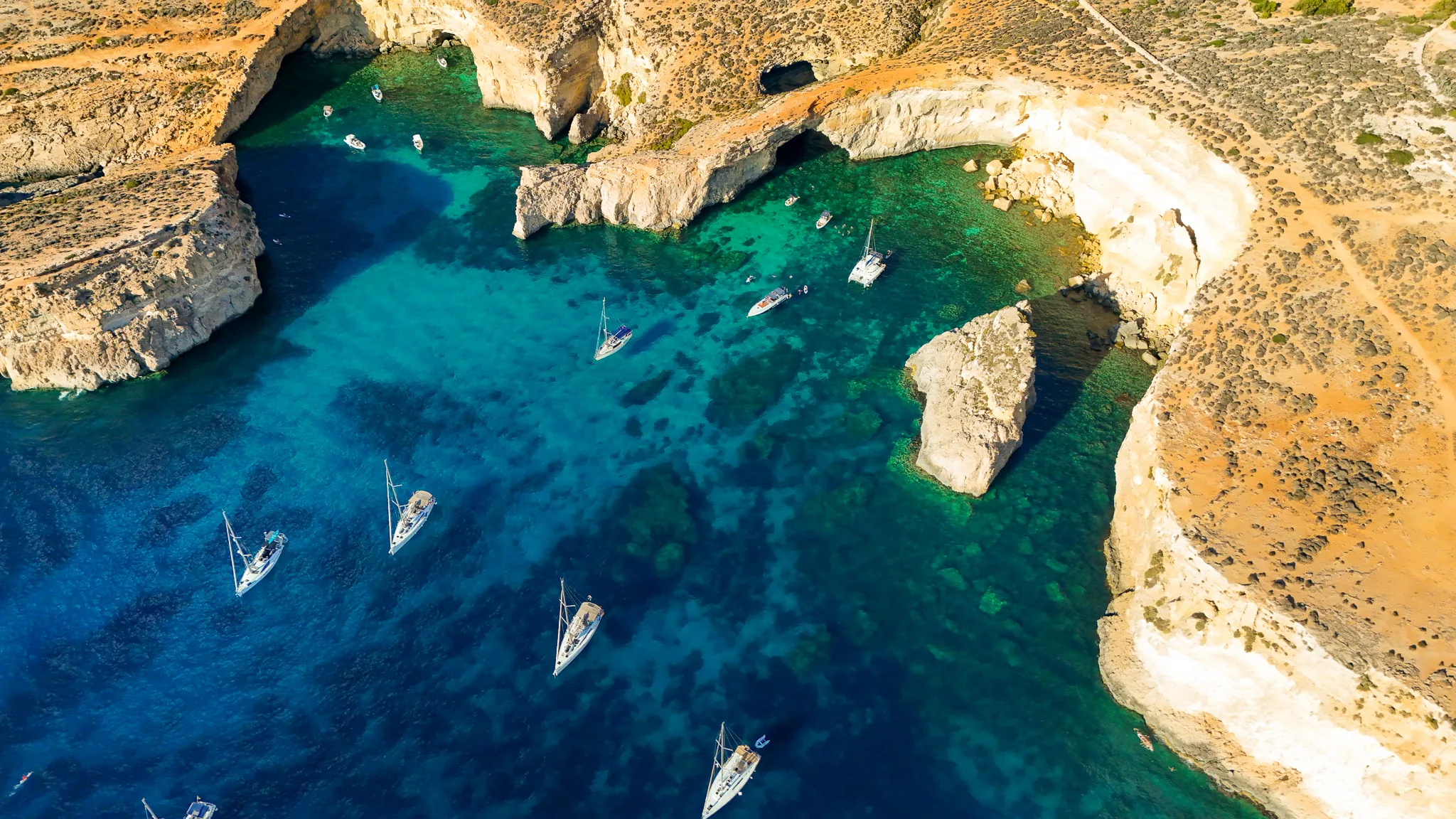
Every private boat tour we run around Comino passes the coastline that Abulafia saw from his cave entrance every morning from 1285 onward. The Blue Lagoon channel where the corsairs once hid. The cliffs of Santa Marija Bay. The garigue above Il-Lifrat, unchanged in its essential character from the island he knew.
On longer tours that include time ashore — four, six, or eight hours — guests can walk the paths that cross central Comino, past the area where the cave sits beneath its fig tree. Most visitors to Comino spend their entire day on the Blue Lagoon shore and never walk inland at all. The cave, the crosses, the carved altar — they are there for anyone who goes looking.
Comino is beautiful from the water. It is extraordinary when you go deeper into what it actually is — an island that has sheltered corsairs, farming families, hermits, mystics, and the last permanent residents of a community that has been there since Roman times.
Abraham Abulafia found peace here. He wrote his finest work here. And somewhere on this small island, in a cave or on a hillside above the blue water, his story came to an end.
Book your private Comino boat tour here.
For the complete history of Comino, read here.
For who lives on Comino today, read here.
For the complete Comino guide, read here.
For the farming history of Comino, read here.
FAQ — Abraham Abulafia and Comino Malta
Who was Abraham Abulafia?
Abraham Abulafia was a 13th century Jewish philosopher and mystic born in Zaragoza, Spain in 1240. He founded the school of Prophetic Kabbalah — a form of Jewish mysticism that taught people to achieve direct spiritual experience through meditation, Hebrew letter combinations, and breath techniques. He is considered one of the most influential Kabbalistic thinkers in Jewish history.
Why did Abraham Abulafia come to Comino?
After being rejected by Jewish communities in Sicily and having nearly been executed by the Pope in Rome, Abulafia needed a place of isolation and quiet. Comino in 1285 was largely uninhabited — most people had retreated inland from the Maltese coastlines because of corsair raids. The island gave him the silence and time he needed to write.
What did Abulafia write on Comino?
Two books. Sefer ha-Ot — the Book of the Sign — written between 1285 and 1288. And Imrei Shefer — Words of Beauty — written in 1291. The second is considered his finest and most accessible work. After 1291 all trace of him disappears.
Where did Abulafia live on Comino?
Near the Il-Lifrat area in central Comino there is a cave with two entrances, sheltered by a fig tree, with multiple crosses carved into the rock walls and what appear to be carved altar shapes. This matches the cave documented by archaeologist Keith Buhagiar and is believed to be where Abulafia lived and wrote.
Did Abulafia die on Comino?
Nobody knows. After writing Words of Beauty in 1291 all historical record of him stops. He may have died on Comino, or he may have left. His grave has never been found.
Why did the Pope want to burn Abulafia?
Abulafia went to Rome in 1280 intending to convert Pope Nicholas III to Judaism as part of his vision of unifying the Abrahamic faiths. The Pope ordered him burned at the stake. Abulafia arrived to find the Pope had died of a stroke the night before. He was imprisoned for four weeks and then released.
How did Abulafia influence literature and culture?
His theory of language is believed to have influenced Dante Alighieri. Umberto Eco based significant elements of his novel Foucault’s Pendulum on Abulafia’s Kabbalistic thought. His meditation techniques influenced Jewish mysticism for centuries.
Is there a connection between Abulafia and Malta today?
Yes. The Admor — the leader of the international Jewish community in Malta — claims to be a direct descendant of Abraham Abulafia. He founded the United Order of Light in 2013, an organisation working toward interfaith unity — the same vision Abulafia pursued 700 years earlier.
Can you visit the cave where Abulafia lived on Comino?
The cave near Il-Lifrat is on the island of Comino, accessible on foot from Santa Marija Bay. Longer private boat tours — four hours and above — that include time ashore give guests the opportunity to walk to this area. Most visitors to Comino never leave the Blue Lagoon shore and never find it.
What is Prophetic Kabbalah?
Prophetic Kabbalah is the school of Jewish mysticism founded by Abraham Abulafia. It teaches that through specific meditation techniques — combining Hebrew letters, breath work, and physical practices — a person can achieve a direct prophetic experience of God, without needing religious intermediaries. It was considered radical and dangerous by the religious authorities of the 13th century.
Further Reading
- The Secret History of Comino — Pirates, Knights and War
- Who Lives on Comino? The Last Residents
- The Forgotten Farming History of Comino
- The History of the Blue Lagoon Malta
- Comino Island Malta — Complete Guide 2026
- Crystal Lagoon Malta — Complete Guide
- Blue Lagoon Malta — Complete Guide 2026
- Best Things To Do on Comino 2026
- Santa Marija Bay Comino — Complete Guide
- Comino Sea Caves — Complete Guide