



Local wildlife guide · Updated August 2026
Dolphin Watching in Malta: Where and When to Spot Wild Dolphins
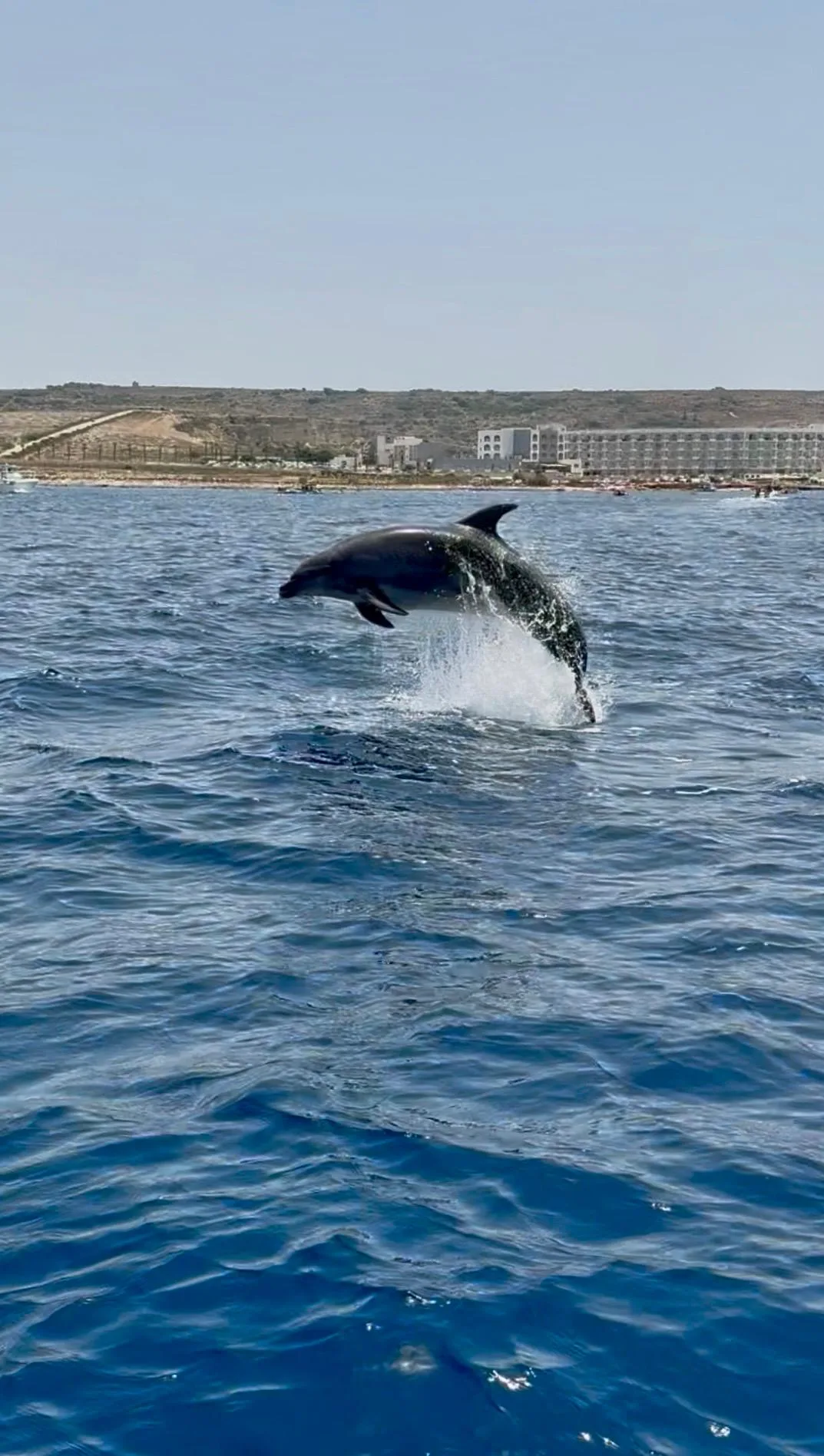
Wild dolphins are regularly recorded in the waters around Malta, Gozo and Comino. Seeing them is unforgettable—but they are not performers and no responsible boat operator can guarantee a sighting. This guide combines official conservation information with our first-hand observations from operating private boat trips since 2016.
The quick answer
Can you see dolphins in Malta? Yes. Local boaters encounter wild dolphins throughout the year. Based on our experience, the most promising areas include southeast Comino, the channel south of Comino, St Paul’s Islands, northwest Malta, Gozo’s north and northwest coast, and the sea between Marsaskala and Marsaxlokk.
Best time: early morning or late afternoon. Important: sightings are never guaranteed, and the dolphin—not the boat—should decide how close the encounter becomes.
Are there dolphins around Malta?
Yes. Malta’s Environment and Resources Authority lists the bottlenose dolphin, short-beaked common dolphin and striped dolphin among the species regularly occurring in Maltese waters. Risso’s dolphins are also recorded, but less frequently.
Official monitoring has reported dolphins throughout Malta’s marine waters, while day-to-day encounters remain naturally unpredictable. A location that produces a beautiful sighting one morning can be completely quiet the next.
Best places to see dolphins in Malta, Gozo and Comino
The locations below are based on our practical observations at sea, not a promise that dolphins will be present. Some sightings happen near the coast; others occur further offshore.
| Area | What we have observed | Useful local context |
|---|---|---|
| Southeast of Comino | One of our most consistent areas for encountering pods, often a little further from the coastline. | A private route can leave Comino’s sheltered lagoons and carefully scan the more open water. |
| South Comino channel | We have seen dolphins in the channel between Comino and Malta, including our memorable pod of eight. | This area can form part of a route from Comino towards St Paul’s Islands. |
| St Paul’s Islands | A good area to watch the water carefully, with dolphins sometimes appearing close enough for clear views. | It is one of the most practical areas to combine with a longer private trip from northern Malta. |
| Northwest Malta | Dolphins can become especially active ahead of changing weather and may leap more visibly. | Never go out because a storm is approaching. Weather and sea safety always come before a possible sighting. |
| North and northwest Gozo | The stretch between Marsalforn and Dwejra can produce sightings, including offshore from Wied ir-Raħeb. | This is a longer, exposed coastline and requires the right weather and sufficient tour time. |
| South Malta | Dolphins are also seen in the waters between Marsaskala and Marsaxlokk. | This is separate from our usual Comino route but remains an important Maltese sighting area. |
Visitors who want to understand the coastline before choosing a route can also read our guides to exploring Gozo by boat and choosing a Malta boat tour.
What is the best time to see dolphins in Malta?
Best time of day
From our experience, early morning and late afternoon give the best realistic opportunity. The lower light also makes it easier to notice splashes, fins and movement across the surface.
Best months
Dolphins may be encountered throughout the year. We have not found one month that can honestly guarantee better results than every other month.
Distance from land
It varies. Around southeast Comino, St Paul’s Islands and Wied ir-Raħeb, they can sometimes be relatively close to land. On other days, a pod may remain well offshore.
Weather changes
Dolphins sometimes leap higher before a storm or among larger waves. That is interesting behaviour to witness from a safe position, but it is never a reason to operate in unsafe conditions.
Our most memorable recent dolphin encounter
Our latest unforgettable encounter happened in the channel south of Comino, between Comino and Malta. We were travelling at a medium speed when we noticed a pod of around eight dolphins.
We immediately slowed and allowed the animals to choose what happened next. Two dolphins began swimming beneath the boat while our guests took photographs. Others remained close by, and one repeatedly leapt high out of the water.
Two came so close that we could clearly see a dolphin’s eye. It was a magical moment for us and for every guest onboard.
What made the encounter special was not that we chased the pod. We slowed, stayed predictable and gave them room. They decided to approach us.
How to watch dolphins responsibly from a boat
Dolphins are intelligent, social wild animals. Boat noise, sudden turns and repeated pursuit can interrupt travelling, feeding, resting or caring for calves. Responsible observation protects the pod and usually creates a calmer, more natural encounter.
- Slow down early. Reduce speed as soon as dolphins are spotted and avoid sudden acceleration, reversing or sharp changes of direction.
- Never race towards the pod. Travel calmly and broadly parallel to its direction. Do not approach head-on, block its route or position the boat inside the group.
- Let the dolphins approach. If they choose to swim near the bow, maintain a steady, predictable course and avoid sudden changes.
- Keep voices and extra noise low. Excited shouting and deliberate underwater noise may disturb the animals. Enjoy the moment quietly.
- Never feed dolphins. Feeding changes their natural hunting behaviour and can make wild animals dependent on or overly confident around boats.
- Do not touch or swim with them. If swimming is included in your trip, wait until the dolphins have left and swim later at an appropriate lagoon or bay.
- Give mothers and calves extra space. Never pass between a mother and her young or separate individuals from the pod.
- Know when to leave. If the pod changes direction repeatedly, dives suddenly, moves away or appears unsettled, increase the distance calmly.
These principles follow the central idea in international cetacean-watching guidance: the animals should determine the nature and duration of the interaction.
What if you see dolphins from a jet ski?
Slow down immediately, keep a generous distance and do not pursue them. A fast or unpredictable approach is likely to make dolphins leave and creates unnecessary collision risk. Let them decide whether to come nearer. Our wider Malta, Gozo and Comino water guide also explains how to enjoy marine life without chasing or disturbing it.
How to photograph dolphins from a boat
Dolphins surface quickly, so preparation matters more than expensive equipment.
- Learn Burst mode before the trip. On many phones, holding or sliding the shutter control captures several frames. The exact gesture varies by model, so test it before boarding.
- Use video when dolphins approach the bow. Video is often easier than predicting the exact moment a dolphin will break the surface.
- Keep the sun behind you when possible. If the light falls onto the dolphin rather than directly into the lens, the wet skin can sparkle and show more detail.
- Try a sunset silhouette only if conditions align. A dolphin jumping between the camera and a low sun can create an exceptional silhouette, but it requires professional timing and plenty of luck.
- Start wide. Excessive digital zoom makes it harder to follow a fast-moving animal. Capture the dolphin and its environment, then crop carefully afterwards.
- Clean the lens. Salt spray and fingerprints ruin more phone photographs than people realise.
- Keep yourself secure. Hold a rail or sit safely while photographing. Never lean dangerously over the side for a shot.
Where should you sit?
The bow is often the favourite position when dolphins voluntarily swim beside or beneath the front of the boat. A private boat makes it easier for guests to change position without a large crowd blocking the view—but always move only when the skipper says it is safe.
What to bring for a dolphin-watching boat trip
- A phone or camera with plenty of free storage and a charged battery
- A secure wrist strap or waterproof phone case
- Sun protection, a hat and drinking water
- A towel and swimwear for a later stop at the Blue Lagoon, Crystal Lagoon or another suitable bay
- A light extra layer outside the hottest months
What about seasickness?
If you are prone to seasickness, speak with a pharmacist before the trip. Travel-sickness remedies can have side effects or may be unsuitable for some people, so follow the product instructions and professional advice. Do not wait until you already feel very unwell to ask what preparation would have been appropriate.
Which trip gives you the best chance?
For guests who especially hope to encounter dolphins, our honest recommendation is a three-hour private trip. Tell us about your interest when booking so the skipper can consider it while planning the route and checking the day’s conditions.
A possible plan is to show you the Blue Lagoon and Crystal Lagoon, then leave Comino from the south and continue towards St Paul’s Islands. This creates a chance—never a guarantee—of seeing dolphins south of Comino or around St Paul’s Islands.
You can compare the standard experience in our guide to a private Comino and Blue Lagoon boat trip, or view the connected iMalta Boat Trips page for the three-hour private boat option.
Want us to include dolphin spotting in your route?
Book a private trip and tell us in advance that dolphins are one of your priorities. We will plan responsibly around the weather and sea conditions while still giving you the option to enjoy Comino’s lagoons and caves.
No false promises: dolphins are wild, so a sighting can never be guaranteed. When you book directly, your skipper and fuel are included, with no hidden charter charges.
Private boat, group cruise or watching from land?
Private boat
The most flexible option. A skipper can adjust the route within the time, weather and safety limits, and guests can move between viewing positions more easily.
Group cruise
Usually follows a fixed timetable and route. It may still encounter dolphins, but the vessel cannot normally change the day around one family’s wildlife interest.
Watching from land
The lowest-impact option, especially from a high coastal viewpoint. A sighting may be distant, so binoculars and patience are useful.
Jet ski or self-drive boat
Never chase a reported sighting. Slow down, remain predictable, provide an open escape route and let the dolphins choose whether to approach.
Frequently asked questions
Can you see dolphins in Malta?
Yes. Bottlenose, common and striped dolphins are regularly recorded in Maltese waters, while Risso’s dolphins are seen less often. Any individual boat trip may or may not encounter them.
Where is the best place to see dolphins in Malta?
Based on our local experience, promising areas include southeast Comino, the south Comino channel, St Paul’s Islands, northwest Malta, Gozo’s northern coast and the sea between Marsaskala and Marsaxlokk.
What is the best time of day for dolphin watching?
We most often recommend looking early in the morning or late in the afternoon. Dolphins can still appear at other times.
What is the best month to see dolphins in Malta?
Dolphins may be seen throughout the year. There is no month in which an ethical operator can guarantee a sighting.
Can a Malta dolphin tour guarantee sightings?
No. Dolphins are wild animals that travel, hunt, rest and socialise freely. We can visit areas where we have encountered them before, but their presence can never be promised.
Can you swim with wild dolphins in Malta?
You should not enter the water to pursue or interact with wild dolphins. Enjoy them from a respectful distance and save your swimming stop for a lagoon or bay after the pod has moved away.
How should a boat approach dolphins?
Slow down, stay calm and travel predictably without blocking the pod. Do not chase, surround, feed or touch the dolphins. Allow them to decide whether they approach the boat.
Which boat trip is best if dolphins are a priority?
We recommend allowing at least three hours and telling us in advance. A possible route combines Comino’s lagoons with the south Comino channel and St Paul’s Islands, subject to weather, sea conditions and the skipper’s judgement.
Are dolphin-watching trips suitable for children?
A private boat can work well for families because the experience is flexible and uncrowded. Children must follow the skipper’s safety instructions and wear the correct life jacket when required.
Final advice from the water
The perfect dolphin encounter cannot be ordered from a timetable. It happens when preparation, patience and luck come together. Choose a sensible route, keep your expectations honest and respect the animals when they appear.
Take the photographs, but also lower the phone for a moment. Seeing a wild dolphin’s eye beside the boat—or watching a pod cross open water together—is the kind of Malta memory that no staged attraction can reproduce.
Conservation and practical sources
- Environment and Resources Authority: cetaceans around the Maltese Islands and their legal protection
- Environment and Resources Authority: marine mammal monitoring and regularly occurring species
- ACCOBAMS: guidelines for managing cetacean-watching activities
- NHS: motion-sickness information and pharmacist advice